
How Much Does a Tattoo Cost? An Honest Guide to Tattoo Prices
Two tattoos the same size can differ in price by five times and both be fair. Here is how artists really charge, what drives the price, and the costs people forget to budget for.
 Save
Save
Ask "how much does a tattoo cost" and you will get an answer that sounds evasive: it depends. Frustrating, but true. Two tattoos the same size can differ in price by a factor of five, and both can be fairly priced.
Want a number for your own idea? Try our tattoo cost calculator for the UK, US, Spain and Mexico.
Before the numbers, one thing worth knowing: there is no official price index for tattoos. No government agency tracks it, and the figures you find online come from studios, supply companies and pricing blogs, most of which are quoting each other. What follows is the range US studios commonly advertise, and more usefully, how pricing actually works, so you can judge any quote you are given.
The three ways artists charge
The shop minimum
Almost every studio has a minimum charge, commonly somewhere around $80 to $150 in the US. It applies even to a tiny heart on the wrist, and people are often surprised by it. The reason is simple: before a single line goes down, the artist has to prepare the design, set up a sterile station, use single-use needles, cartridges, ink caps, gloves and barrier film, and then break it all down and disinfect afterwards. That overhead is the same whether the tattoo takes ten minutes or two hours.
By the hour
Medium and large custom work is usually billed hourly. Commonly advertised rates run from roughly $100 an hour for newer artists to $150 to $250 for established ones, and considerably more for well-known names or specialists in demanding styles like photorealism. Big cities with high studio rents sit at the top of that range.
Some artists doing very large projects quote a day rate instead, a fixed price for a full session, which often works out a little cheaper than paying the equivalent hours.
By the piece
Flash designs, the pre-drawn artwork on a studio's walls or social media, usually come with a set price. Many artists also give a flat quote for custom pieces once they have seen the design, size and placement. A flat price protects you from a session running long, and protects the artist from a client who needs constant breaks.
What actually drives the price
Size, but less than you would think. A larger tattoo costs more, but a small piece with fine detail can take longer than a bigger bold one. Price follows time, and time follows detail.
Detail and style. Bold traditional work with solid colour moves quickly. Fine line, dotwork, heavy shading and realism are slow. Colour generally takes longer than black and grey because each colour has to be packed and blended.
Placement. Areas where skin is thin, stretchy or awkward to reach, like ribs, hands, feet and the neck, are slower to work on. As we covered in our look at tattoo pain by body part, they are often the areas where clients need more breaks, which adds time too.
The artist. Experience, reputation and waiting list all push the rate up. An artist booked months ahead is priced for demand, not just skill.
Location. Studio rent, local wages and licensing costs vary enormously between a major city and a small town, and prices follow.
Custom design time. Some artists fold drawing time into the price. Others charge for it separately, particularly for complex pieces that need several revisions.
Typical ranges, with a large pinch of salt
These are the ranges US studios commonly advertise. Your local reality may sit well above or below them.
- Small and simple (a few centimetres, basic linework): usually the shop minimum, roughly $80 to $250.
- Palm sized with shading or colour: often $200 to $500.
- Half sleeve or large back piece: commonly $1,000 to $3,000 or more, spread across several sessions.
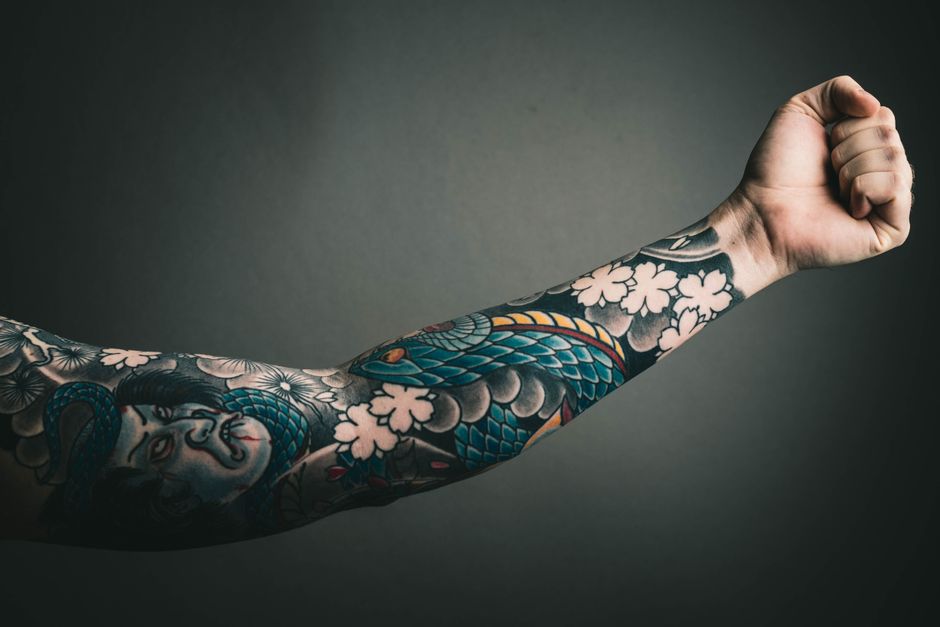
- Full sleeve: frequently $2,000 to $5,000, and well beyond that for detailed realism or in-demand artists.
- Full back piece or bodysuit work: can reach five figures over years of sessions.
If a quote lands far below the local going rate, ask why. The difference is usually made up somewhere, whether in experience, hygiene or the time the artist is willing to spend on your piece.
The costs people forget
The deposit. Most studios take a deposit to book, which normally comes off the final price. It is often non-refundable if you cancel late or fail to turn up, because the artist has already spent time drawing your design and has turned away other work for that slot.
The tip. In the US, tipping tattoo artists is customary, and 15 to 20 percent is the figure most commonly cited. In the UK and much of Europe, tipping is appreciated but far less expected. Budget for it where it is the norm.
Aftercare. A fragrance-free moisturiser and a gentle cleanser are not expensive, but they are part of the cost. Our guide to tattoo aftercare products covers what is worth buying.
Touch ups. Many artists offer a free touch up within a few months if an area heals patchy, as long as you followed aftercare instructions. Ask about this before you book, not after.
Multiple sessions. Large pieces are almost never finished in one sitting. A sleeve quoted at an hourly rate may take many sessions across months, and you pay for each.
Tipping customs vary by country; see how much to tip a tattoo artist.
Why cheap is the most expensive option
A tattoo is one of the few purchases where going cheap can cost you far more later. Fixing bad work with a cover up is harder than tattooing fresh skin, because the new design has to be larger and darker to hide what is underneath. Laser removal is slower and pricier still, usually taking many sessions spaced weeks apart. We looked at why the shortcuts go wrong in our piece on at-home tattoo removal.
Regret is not rare either. A 2023 Pew Research Center survey found that 24 percent of tattooed Americans had regretted getting at least one of their tattoos. We broke down what people regret most, and rushed decisions made on price come up again and again.
How to get an honest quote
- Send a clear brief. Reference images, the size in centimetres or inches, placement, and whether you want colour or black and grey. Vague requests get vague quotes.
- Ask how they charge. Hourly, flat or day rate, and whether drawing time is included.
- Ask for a time estimate if you are paying hourly, and how many sessions they expect.
- Clarify the deposit terms: how much, whether it comes off the final price, and what happens if you need to reschedule.
- Look at healed work in the artist's portfolio, not just fresh photos taken minutes after tattooing.
And do not haggle over the price of something permanent. If the quote is more than you can afford, it is far better to go smaller, simplify the design, or save for a few more months than to push an artist to rush. Before you commit, it is also worth reading our list of red flags to watch for before getting tattooed.
A good tattoo is expensive because good tattooing is slow, skilled and hygienic. You pay for it once. A bad one you tend to pay for twice.
Price ranges in this article reflect rates commonly advertised by US tattoo studios and are not drawn from an official price survey, as none exists. Regret figure from the Pew Research Center, "32% of Americans have a tattoo, including 22% who have more than one," August 2023.
News Tattoos
Tattoo enthusiast and writer at News Tattoos. Passionate about tattoo art, culture, and the stories behind the ink. Covering the global tattoo community since 2022.
Get one tattoo story a day on Telegram
New guides, meanings and tattoo news, straight to your phone. Free, no spam.
Keep reading
 Tattoo Aftercare & Tips
First Tattoo Guide: Everything to Know Before Your First Tattoo
Tattoo Aftercare & Tips
First Tattoo Guide: Everything to Know Before Your First Tattoo
 Tattoo Aftercare & Tips
Tattoo Pain by Body Part: What the Evidence Actually Says
Tattoo Aftercare & Tips
Tattoo Pain by Body Part: What the Evidence Actually Says
 Tattoo Aftercare & Tips
Tattoo Red Flags: 15 Warning Signs to Watch For Before You Get Tattooed
Tattoo Aftercare & Tips
Tattoo Red Flags: 15 Warning Signs to Watch For Before You Get Tattooed
 Tattoo Aftercare & Tips
How to Sleep With a New Tattoo: Positions and Bedding Tips
Tattoo Aftercare & Tips
How to Sleep With a New Tattoo: Positions and Bedding Tips