
Evil Eye Tattoo Meaning: History, Designs and Placement Ideas
The evil eye tattoo is not the curse, it is the protection against it. Here is where the symbol comes from, what it means in Turkish, Greek, Jewish, Islamic and Latin American tradition, and the designs that work best.
 Save
Save
Few tattoo designs carry as much history in so little space as the evil eye tattoo. A few concentric circles of blue and white, sometimes no bigger than a fingernail, and it connects you to a belief recorded across the ancient Mediterranean and still alive from Istanbul to Athens to Mexico City.
If you are considering one, it helps to know what the symbol actually means, because it is widely misunderstood. The evil eye tattoo is not the curse. It is the protection against it.
What the evil eye actually is
The "evil eye" is a belief that a look, usually one driven by envy, can cause harm. Someone admires your baby, your new house or your good fortune a little too intensely, and misfortune follows. The person doing the looking may not even mean any harm.
The blue eye charm that most people now call an "evil eye" is technically the answer to that threat. It is an amulet meant to stare back, deflecting or absorbing the harmful gaze before it reaches you. So when someone gets an evil eye tattoo, they are wearing a permanent shield.
A belief older than most religions
The idea is ancient. Eye idols with carved eyes have been excavated at Tell Brak in Mesopotamia, one of the oldest cities in the region, and the concept appears in texts from the Bronze Age city of Ugarit. Classical Greek and Roman writers from Plato to Plutarch discussed it, and the Roman author Pliny the Elder wrote about people said to have "the power of fascination with the eyes."
Once glassmaking spread around the Mediterranean, from roughly 1500 BC, eye beads followed. Over the centuries they were adopted by Phoenicians, Persians, Arabs, Greeks, Romans and later the Ottomans, which is why the symbol feels at home across such a huge stretch of the world.
The same idea, many names
One reason the evil eye makes such a personal tattoo is that almost every culture around the Mediterranean and beyond has its own version. Knowing yours can shape the design.
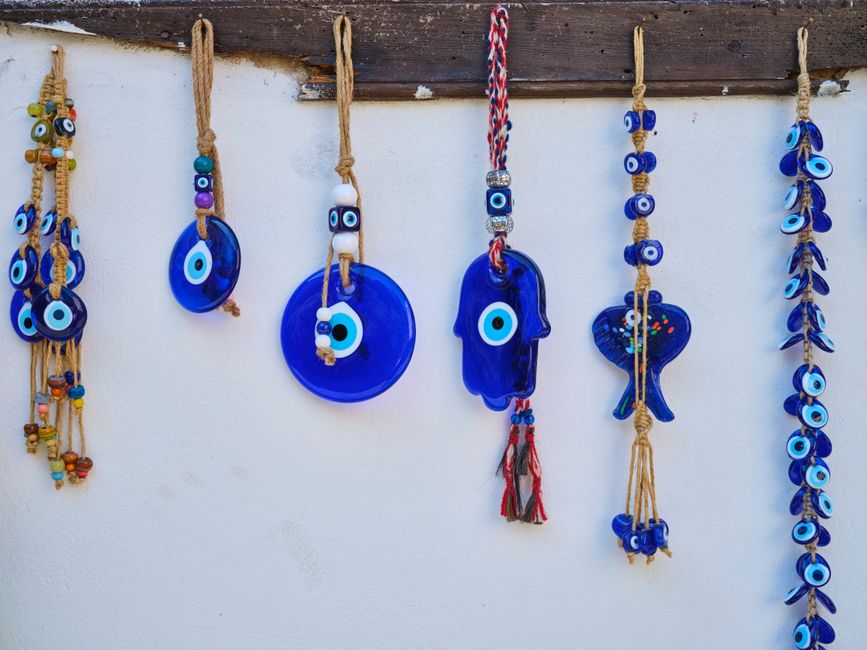
- Turkey: nazar boncuğu. The classic cobalt blue glass bead with white, light blue and dark blue rings. Nazar comes from the Arabic for "look" or "gaze." You will see it on doorways, in cars, pinned to babies' clothes and in bowls at every souvenir stall.
- Greece: mati. Greek families still practise xematiasma, a ritual in which a relative silently recites a prayer passed down through the family, and drops of oil in water are used to test whether someone has been given the eye.
- Italy: malocchio. Italian tradition leans less on the eye bead and more on the cornicello, a small twisted horn traditionally made of red coral or gold.
- The Middle East and North Africa: the hamsa. An open palm, often with an eye in the centre. Hamsa means "five," for the fingers. It is known as the Hand of Fatima in Muslim tradition and the Hand of Miriam in Jewish tradition.
- Jewish tradition: ayin hara. People say b'li ayin hara, "without an evil eye," after mentioning good news, much as others knock on wood.
- Islamic tradition. Many Muslims respond to praise with Masha'Allah, "God has willed it," as a spoken protection against envy.
- Latin America: mal de ojo. Traditional remedies include a healer passing a raw egg over the body to draw the harm out, and red string bracelets are common protective charms for children.
Why is it blue?
There are several explanations, and none is definitive. One is that in parts of the Aegean, where blue eyes were rare, people with pale eyes were thought especially likely to cast the curse, so a blue eye was used to fight fire with fire. Another is simply material: cobalt and copper gave early glassmakers a durable, striking blue. Whatever the origin, the classic nazar colours of dark blue, white, light blue and a dark centre are now so recognisable that they read as an evil eye even in a tiny tattoo.
Popular evil eye tattoo designs
The classic nazar
Concentric blue and white circles, faithful to the glass bead. It works beautifully small, and it is the most instantly recognisable version. Ask your artist about colour longevity: light blue can soften over time, so a strong dark outline helps the design stay crisp.
Hamsa with an evil eye
Combining the hand and the eye doubles up on protective meaning and gives the artist more to work with. It suits the forearm, back of the neck, upper back or sternum, where there is room for detail inside the palm such as mandala patterns or dotwork.
Fine line and minimalist
A single line almond eye, sometimes with just a dot of blue for the iris. Popular on fingers, behind the ear and on the inner wrist. The trade off is that very fine, very small tattoos are more likely to blur as they age, so let your artist tell you the minimum size that will hold.
Realistic eye
Some people prefer a lifelike human eye rather than the stylised bead. In black and grey or colour realism, it becomes a striking statement piece, and pairs well with protective imagery like wings, snakes or florals.
Geometric and ornamental
Eyes set inside triangles, circles or sacred geometry patterns, or woven into a mandala. Be aware that an eye inside a triangle is also associated with the Eye of Providence, which carries its own separate religious and cultural meanings.
Evil eye with other symbols
Common pairings include a crescent moon, a sun, stars, a red string, beads strung like a bracelet around the wrist or ankle, or names and dates for a child the tattoo is meant to protect.
Where to place an evil eye tattoo
- Fingers and hands: the most traditional feeling spot for a small nazar, since it echoes a ring or charm. Hand and finger tattoos fade faster than most, though, and often need touch ups.
- Wrist and ankle: perfect for a bracelet or anklet of eye beads.
- Behind the ear or back of the neck: discreet, and fitting for a symbol meant to watch your back.
- Sternum and upper back: good for larger hamsa and ornamental designs.
- Forearm: easy to see yourself, which some people prefer for a protective symbol.
Some of these spots are notably more sensitive than others. Our guide to tattoo pain by body part explains what to expect.
Is an evil eye tattoo cultural appropriation?
It is a fair question, and the honest answer is that the evil eye is one of the most widely shared symbols in the world, used across many religions and nationalities rather than belonging to one closed community. That said, it still means something real to a lot of people. A few things keep it respectful: learn which tradition your design draws from, avoid mixing it with sacred imagery you do not understand, and take the meaning seriously rather than treating it as just a pretty pattern. We cover the broader idea of meaning in tattoos elsewhere.
Before you book
Small symbolic tattoos are exactly the kind people get on impulse, so choose an artist whose fine detail and colour work you can see healed in their portfolio, not just fresh. Our list of tattoo red flags will help you vet a studio, and if you are wondering about budget, most small evil eye tattoos fall at or near a studio's minimum charge, as explained in our guide to how much a tattoo costs.
If words are more your thing than symbols, our guide to blessed tattoos covers another design people choose for gratitude and protection.
News Tattoos
Tattoo enthusiast and writer at News Tattoos. Passionate about tattoo art, culture, and the stories behind the ink. Covering the global tattoo community since 2022.
Get one tattoo story a day on Telegram
New guides, meanings and tattoo news, straight to your phone. Free, no spam.
Keep reading
 Tattoo Inspiration & Ideas
Couple Tattoo Ideas You Won't Regret
Tattoo Inspiration & Ideas
Couple Tattoo Ideas You Won't Regret
 Tattoo Inspiration & Ideas
Tree of Life Tattoo Meaning: Symbolism Across Cultures and Design Ideas
Tattoo Inspiration & Ideas
Tree of Life Tattoo Meaning: Symbolism Across Cultures and Design Ideas
 Tattoo News & Events
Good Luck Tattoos: Symbols, Meanings and Where They Come From
Tattoo News & Events
Good Luck Tattoos: Symbols, Meanings and Where They Come From
 Tattoo Culture & History
Sak Yant Tattoo Meaning: Designs, Rules and How to Get One Respectfully
Tattoo Culture & History
Sak Yant Tattoo Meaning: Designs, Rules and How to Get One Respectfully